Attention Is All You Need: How the Transformer Paper Built Modern AI
A clear guide to the 2017 Transformer paper, self-attention, and why ChatGPT, Claude, and Gemini all run on the same core architecture.
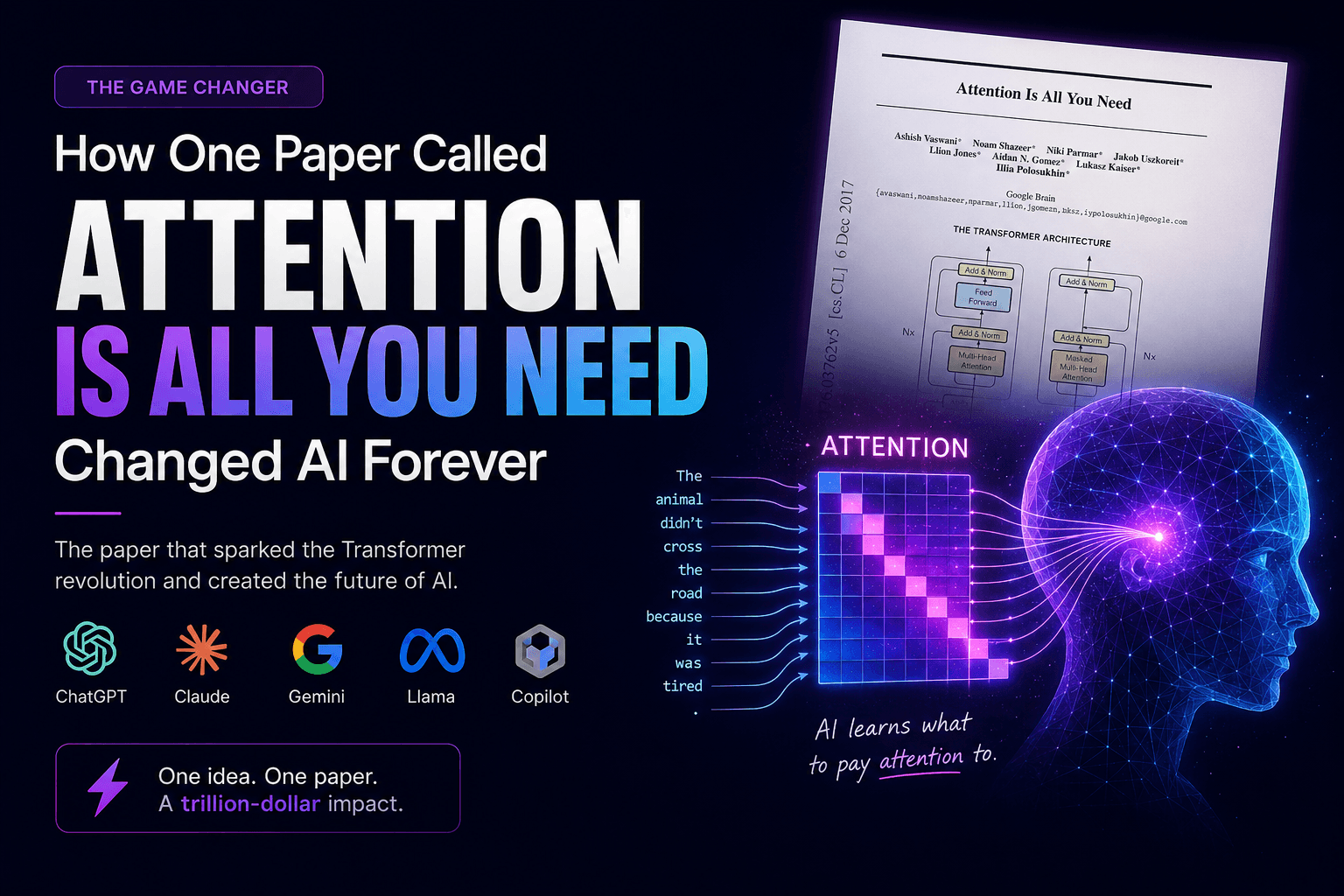
In June 2017, eight researchers at Google published a paper with a bold title: Attention Is All You Need (Vaswani et al., 2017). It proposed the Transformer, a neural network architecture that did not read text one word at a time. Instead, it used self-attention to weigh every word against every other word in a single pass.
That design choice sounds technical. Its consequences were not. Within a few years, the Transformer became the foundation for GPT, BERT, Claude, Gemini, Llama, and nearly every major language model you use today. If you want to understand modern AI, this paper is the right starting point.
One sentence summary
The Transformer replaced slow, sequential language models with a parallel architecture built on self-attention, which scaled to the large language models behind ChatGPT and every major AI assistant.
Why older language models hit a wall
Before Transformers, most language AI relied on recurrent neural networks (RNNs) and LSTMs. They processed tokens in order: read a word, update hidden state, read the next word. That matched how humans read, but it created three hard limits.
First, long-range memory was weak. By the time the model reached the end of a long paragraph, signals from the beginning had often faded, a problem researchers call vanishing gradients (Hochreiter, 1998).
Second, training was slow. Each token depended on the previous one, so GPUs could not fully parallelize the sequence. Scaling to internet-sized data was painful.
Third, bigger RNNs did not keep getting smarter at the same rate modern AI now expects. The architecture itself was the bottleneck.
Researchers needed a model that could see the whole sentence at once, learn which words matter for which other words, and train in parallel across thousands of GPU cores.
What self-attention actually does
Attention means: when the model processes one word, it asks which other words in the sentence are most relevant right now.
Consider: The trophy did not fit in the suitcase because it was too large. Humans know it refers to the trophy. Self-attention learns those links from data by computing a relevance score between every pair of positions (Bahdanau et al., 2015; Vaswani et al., 2017).
In a Transformer:
- Each token is turned into a vector (an embedding).
- For each position, the model computes Query, Key, and Value vectors.
- Attention scores decide how much each position should borrow from the others.
- Stacked encoder and decoder layers repeat this with feed-forward networks and residual connections.
The famous multi-head attention runs several attention patterns in parallel, so one head might track grammar while another tracks meaning (see The Illustrated Transformer by Alammar, 2018, for a visual walkthrough).
Why the title was provocative
Recurrence used to be considered essential for language. The paper argued attention alone, without RNN cells, could match or beat state of the art on translation. That claim rewrote the field.
Parallel training unlocked scale
The hidden superpower was not only smarter text. It was compute.
Because every position can attend to every other position in parallel (within a sequence length), Transformers map cleanly onto GPU matrix multiplication. That alignment let teams train on far more data and far larger models than RNNs allowed.
OpenAI's GPT line (Generative Pre-trained Transformer) showed what happens when you scale this architecture: pre-train on huge text corpora, then fine-tune or instruct for chat (Radford et al., 2018; Brown et al., 2020). Google, Meta, Anthropic, and others followed the same blueprint.
Empirical work on scaling laws later showed that model size, data, and compute predictably improve capability (Kaplan et al., 2020), which turned Transformers into an infrastructure race as much as a research story.
From research paper to ChatGPT
None of this felt inevitable in 2017. The paper was one among thousands. But benchmarks on machine translation improved fast. Transformers spread to summarization, search, code, and generation.
When ChatGPT went public, many people thought AI had become intelligent overnight. In reality, the public was seeing years of Transformer scaling: better context, smoother dialogue, and instruction tuning on top of the same core architecture (OpenAI, 2023).
Today, whether you use ChatGPT, Claude, Gemini, or an open model like Llama, you are almost certainly interacting with a descendant of this design.
How Transformers changed NLP benchmarks
On machine translation, the original Transformer beat existing RNN models while training faster (Vaswani et al., 2017). That result mattered because translation was the flagship task of the era. If attention-only models could win there, the same machinery could likely power other language tasks.
Soon, BERT (Devlin et al., 2019) adapted the encoder for understanding tasks like search and classification. GPT adapted the decoder for generation. The industry split into encoder-style, decoder-style, and encoder-decoder systems, but the shared DNA remained self-attention and parallel training.
For readers learning today, the practical lesson is simple: when someone says "LLM," they almost always mean a large decoder-style Transformer trained to predict the next token. The paper you are reading about is the architectural ancestor of that stack.
What you should take away
If you remember three ideas, remember these:
- Self-attention lets the model focus on the right words in context, not just the latest word.
- Parallelism made trillion-token training economically possible.
- Scale on top of Transformers produced the capabilities we now call "general" language AI.
The Grey Project teaches these ideas interactively, without hype. If you want intuition before math, start with our free lesson on AI as prediction.
References
- Bahdanau, D., Cho, K., & Bengio, Y. (2015). Neural machine translation by jointly learning to align and translate. ICLR. https://arxiv.org/abs/1409.0473
- Brown, T. B., et al. (2020). Language models are few-shot learners. NeurIPS. https://arxiv.org/abs/2005.14165
- Hochreiter, S. (1998). The vanishing gradient problem during learning recurrent neural nets and problem solutions. International Journal of Uncertainty, Fuzziness and Knowledge-Based Systems.
- Kaplan, J., et al. (2020). Scaling laws for neural language models. https://arxiv.org/abs/2001.08361
- OpenAI. (2023). GPT-4 technical report. https://arxiv.org/abs/2303.08774
- Radford, A., et al. (2018). Improving language understanding by generative pre-training. OpenAI.
- Devlin, J., et al. (2019). BERT: Pre-training of deep bidirectional transformers for language understanding. https://arxiv.org/abs/1810.04805
- Vaswani, A., et al. (2017). Attention is all you need. NeurIPS. https://arxiv.org/abs/1706.03762
- Alammar, J. (2018). The Illustrated Transformer. https://jalammar.github.io/illustrated-transformer/
About the author
Vaibhav Kestikar is a Senior Data Scientist and the founder of The Grey Project, where he teaches AI through interactive lessons and clear mental models. Connect on LinkedIn.
Continue learning
Turn this article into intuition
Related lesson: AI Is Prediction, free sample